

Yes, you can fry in olive oil
Many people worry that olive oil is unsuitable for the frying pan, but that sits poorly with what the authorities and the research say. The Swedish Food Agency (Livsmedelsverket) recommends frying in oil or liquid cooking fat instead of butter, and names rapeseed oil and olive oil as excellent for the job.
The agency also explains that fat oxidises when heated and that oxidation products form. For vegetable oils with a lot of unsaturated fat the effect is so small that rapeseed oil or olive oil works very well for frying.
The short version: in an ordinary frying pan at home, olive oil works well. The differences are mostly about flavour, price and how hot you want the pan.
What is smoke point, and why does it say so little?
The smoke point is the temperature at which an oil starts to give off continuous, visible smoke in a laboratory test. It is easy to compare, which is why it has become the number everyone asks for when they search for olive oil smoke point.
The trouble is that the figure varies a great deal between samples of the same kind of oil. It depends on free acidity, how fresh the oil is and how it has been refined. In one Australian study an extra virgin olive oil measured about 207 °C, a virgin olive oil about 175 °C and an olive oil about 208 °C. Those are measurements from those particular bottles and do not apply to every oil of the same kind.
Smoke point also says little about how an oil behaves under prolonged heat. The same study concludes that, under its test conditions, smoke point did not predict how an oil performs when heated. Oxidative stability and the share of polyunsaturated fats were better indicators. On the other hand, other research shows that emissions of irritating aldehydes rise sharply once an oil reaches its smoke point, so smoke in the kitchen is a sign to take seriously.
Categories and smoke point: extra virgin, virgin and olive oil
The category decides both flavour and what the smoke point usually looks like. EU marketing standards divide olive oil into eight classes, but only four may be sold to consumers.
- Extra virgin olive oil: pressed directly from olives by mechanical means, with no taste defects at all and free acidity of no more than 0.8 per cent.
- Virgin olive oil: also mechanically pressed, but minor defects are allowed and free acidity may be up to 2.0 per cent.
- Olive oil: a blend of refined olive oil and virgin oil. The flavour is mild and neutral.
- Olive pomace oil: oil extracted from the pressing residue, refined and blended with virgin oil.
Refined oil has been cleaned of flavour and free fatty acids, and is therefore usually measured with a higher smoke point than virgin oils. Extra virgin olive oil keeps its aroma and natural antioxidants, which is also why many people save it for salads and finishing.
The table gives the approximate ranges usually quoted for these oils. Figures differ between sources and between individual bottles, so use them as a direction to start from.
| Oil | Approximate smoke point | Comment |
|---|---|---|
| Extra virgin olive oil | 190 to 215 °C | Varies with acidity and freshness. Keeps flavour and antioxidants. |
| Virgin olive oil | 175 to 210 °C | Slightly higher acidity is allowed, which lowers the smoke point. |
| Olive oil (refined and virgin) | 200 to 240 °C | Mild flavour, a common choice for everyday frying. |
| Olive pomace oil | 210 to 240 °C | Refined oil, usually copes with high heat. |
| Rapeseed oil, refined | 200 to 240 °C | Cold-pressed rapeseed oil sits lower. |
| Sunflower oil, refined | 225 to 250 °C | Neutral flavour, a lot of polyunsaturated fat. |
| Corn oil, refined | 220 to 250 °C | Neutral flavour, a lot of polyunsaturated fat. |
What research says about extra virgin olive oil and heat
Two studies are often mentioned. Casal and colleagues heated different categories of olive oil in a home-style deep-frying set-up and tracked the breakdown until total polar compounds reached the legal limit of 25 per cent. All the olive oils lasted 24 to 27 hours, compared with 15 hours for a commercial vegetable oil blend. The extra virgin oil in the trial showed the lowest oxidation and the most antioxidants left.
De Alzaa and colleagues heated ten common cooking oils to 240 °C and then held them at 180 °C for six hours. Extra virgin olive oil produced the lowest level of polar compounds, while oils rich in polyunsaturated fat, such as canola (rapeseed) oil, broke down faster. The explanation is the fatty acid composition and the oil's natural antioxidants.
Two caveats belong here. The second study was run by an Australian laboratory without any food in the fryer, and water from food can affect how the oil breaks down. Also, heat does destroy some of extra virgin olive oil's fruity aroma and polyphenols, so you do not carry the full character into the pan. The conclusion is that olive oil copes well with frying, though it cannot take everything.
Practical temperatures: pan, deep fryer and oven
| Method | Approximate temperature | Suitable oil |
|---|---|---|
| Medium-heat frying (eggs, vegetables, fish) | 130 to 180 °C | Extra virgin olive oil, olive oil, rapeseed oil |
| High-heat frying (meat, wok) | 180 to 220 °C | Olive oil, rapeseed oil, a mild blend |
| Deep frying | 170 to 180 °C | Neutral frying oil or sunflower oil |
| Oven (oil on a tray or in a marinade) | 180 to 225 °C | Extra virgin olive oil works well |
The temperatures are guidelines. In the oven it is the air that is hot, and the oil on the food usually sits below oven temperature because the water in the food cools it.
When a blend or a neutral oil makes more sense
Extra virgin olive oil is a more expensive ingredient than rapeseed or sunflower oil, and its flavour does not belong in everything. In large-volume deep frying the cost soon shows, and a pronounced olive aroma can interfere with the taste of fried food.
A neutral oil is often the simplest choice for deep frying, very high-heat frying, baking where the flavour should stay discreet, and professional kitchens where the oil is changed often. A blend with a little virgin olive oil in a neutral base can give a hint of olive oil at a lower price.
At home it is easy to do it this way: extra virgin olive oil for salads, finishing and gentle frying, a mild olive oil or rapeseed oil for everyday cooking, and a neutral oil when you are deep frying.
Oils for frying in the Ella's range
The Ella's range includes several oils for different kinds of cooking. The details below come from the product descriptions.
- Olive oil: a blend of 75 per cent refined olive oil and 25 per cent virgin olive oil, with a mild and neutral flavour for daily cooking.
- Olive Oil Mix: virgin olive oil and refined sunflower oil, intended for salads, frying and baking.
- Salad oil: 80 per cent refined sunflower oil and 20 per cent virgin olive oil. Described as suitable for frying and baking at high temperatures, and for salads.
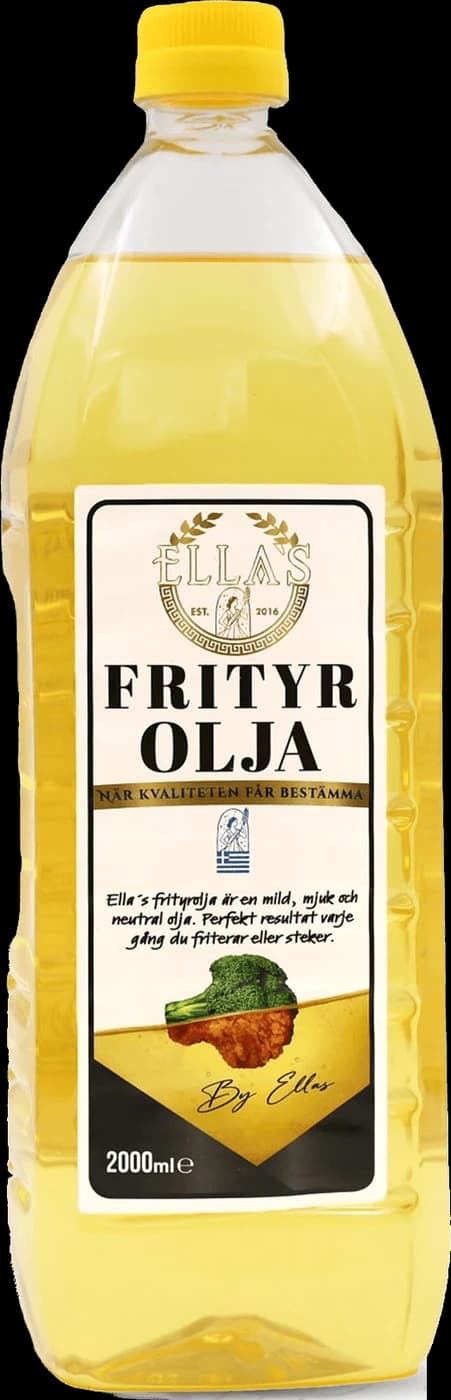
- Frying oil: sunflower oil with an anti-foaming agent, made for deep frying and frying.
The extra virgin olive oils in the range are described as nutty and fruity, with salads and baking as the suggested uses.
Common questions
Can you fry in extra virgin olive oil?
Yes. The Swedish Food Agency says olive oil is excellent for frying, and studies show extra virgin olive oil is stable under heat. Flavour and some aroma and polyphenols do fade at high heat, so many people save it for salads and finishing.
What is the smoke point of olive oil?
There is no single figure. Extra virgin olive oil is usually quoted at around 190 to 215 °C and refined olive oil higher, but the value varies with quality and freshness.
Which olive oil should you fry in?
For everyday frying both extra virgin olive oil and a mild olive oil work. Refined olive oil has a more neutral flavour and is cheaper, while extra virgin gives more character.


Sources
- Matfetter (kostråd för vuxna)Livsmedelsverket
- Evaluation of Chemical and Physical Changes in Different Commercial Oils during Heating (De Alzaa, Guillaume, Ravetti, 2018)Acta Scientific Nutritional Health 2(6)
- Olive oil stability under deep-frying conditions (Casal et al., 2010)Food and Chemical Toxicology 48(10)
- Emissions of volatile aldehydes from heated cooking oils (Katragadda et al., 2010)Food Chemistry 120(1)
- Så här fungerar det nationella kontrollprogrammet för olivoljaLivsmedelsverket
- Delegated Regulation (EU) 2022/2104 on marketing standards for olive oilEuropeiska kommissionen / EUR-Lex

